 The SSD Review The Worlds Dedicated SSD Education and Review Resource |

While attending Computex in Taiwan this past June, The SSD Review had the opportunity to meet with Exascend CEO and Founder Frank Chen, who provided valuable insight into the company’s background and philosophy. Exascend is a NAND flash storage specialty manufacturer with a product portfolio that spans memory cards, DRAM, embedded storage solutions, and enterprise-class SSDs. From the very beginning, however, it was clear that Exascend is anything but a typical storage manufacturer.

Our introduction in Taiwan quickly led to a visit with Exascend’s engineering team in Shanghai, China, where we gained a much deeper appreciation for the company’s capabilities. Exascend could best be described as a boutique storage manufacturer. Rather than simply assembling off-the-shelf components, the company develops its solutions from the wafer level upward, combining in-house hardware, firmware, and software expertise to create highly customized products.
This vertically integrated approach allows Exascend to deliver an exceptionally customer-focused experience. Instead of producing one-size-fits-all products in high volume, the company works closely with customers to tailor storage solutions to exact requirements, offering a level of flexibility and customization that many larger manufacturers simply cannot match.
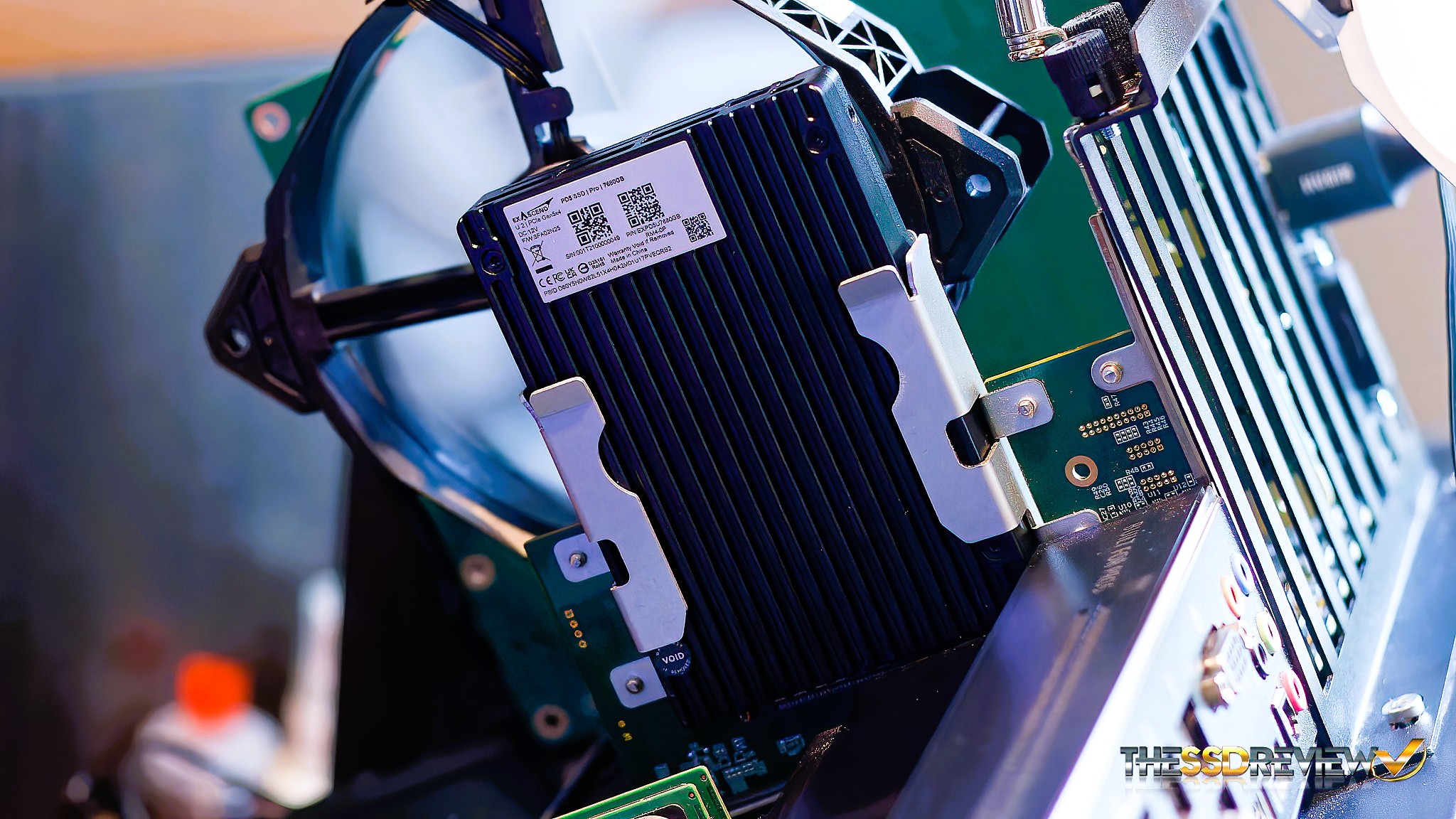
No sooner had we returned from China than the Exascend PD5 Gen5 7.68TB Enterprise SSD arrived on our doorstep. Built on a PCIe 5.0 x4 (four-lane) interface, the PD5 is designed for demanding enterprise workloads, including high-performance computing (HPC), artificial intelligence and machine learning (AI/ML), and data-intensive media production.
The PD5 comes in a U2 form-factor and can be described as a having a ribbed black aluminum two-piece external casing. It took no time at all before this SSD was up and running in our enterprise test bench.
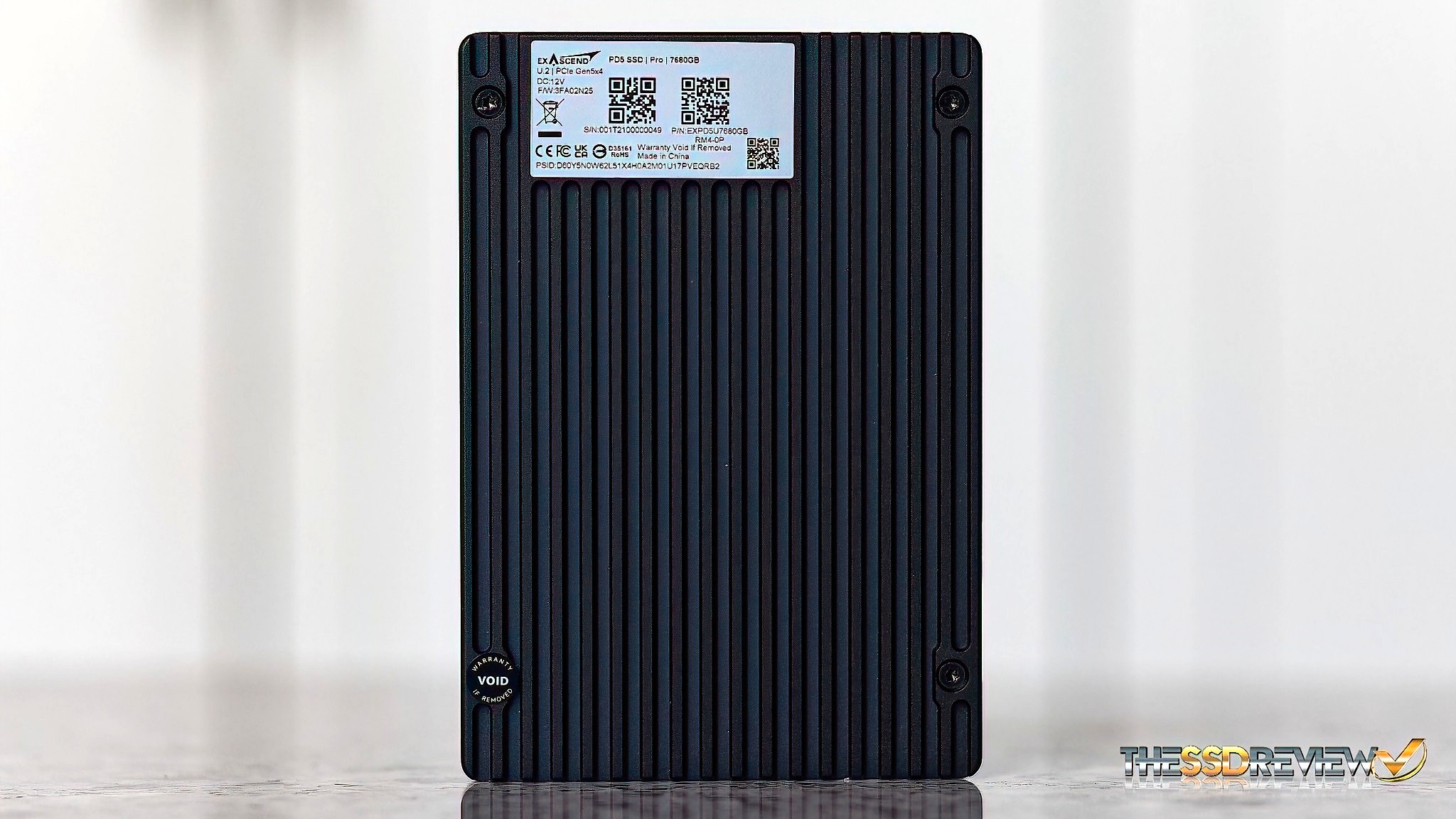
The Exascend PD5 is available in capacities ranging from 7.68TB to 30.72TB and is rated for sequential transfer speeds of up to 14.1GB/s read and 9.35GB/s write, while delivering up to 3.12 million IOPS. Designed for broad enterprise deployment, it supports a wide range of operating systems, including Windows 10/11, Windows Server, CentOS, Fedora, FreeBSD, openSUSE, Red Hat Enterprise Linux, Ubuntu, VMware ESXi, Citrix, and KVM. Enterprise-class features include advanced LDPC error correction, Self-Encrypting Drive (SED) support, and integrated hardware power-loss protection.
At the heart of the PD5 is the Silicon Motion SM8366 PCIe 5.0 x4, 16-channel NVMe SSD controller, paired with 232-layer 3D TLC NAND flash memory. One of the drive’s standout technologies is Exascend’s Dual Power Loss Protection, which combines custom firmware with onboard tantalum capacitors to safeguard data integrity. In the event of an unexpected power failure, the capacitors provide sufficient reserve power for the drive to flush any data remaining in the DRAM cache to NAND flash. Once power is restored, Exascend’s proprietary firmware rapidly reconstructs the Flash Translation Layer (FTL) mapping table, ensuring a fast, accurate, and reliable return to operation.
A complete list of the Exascend PD5’s features and specifications can be found here:
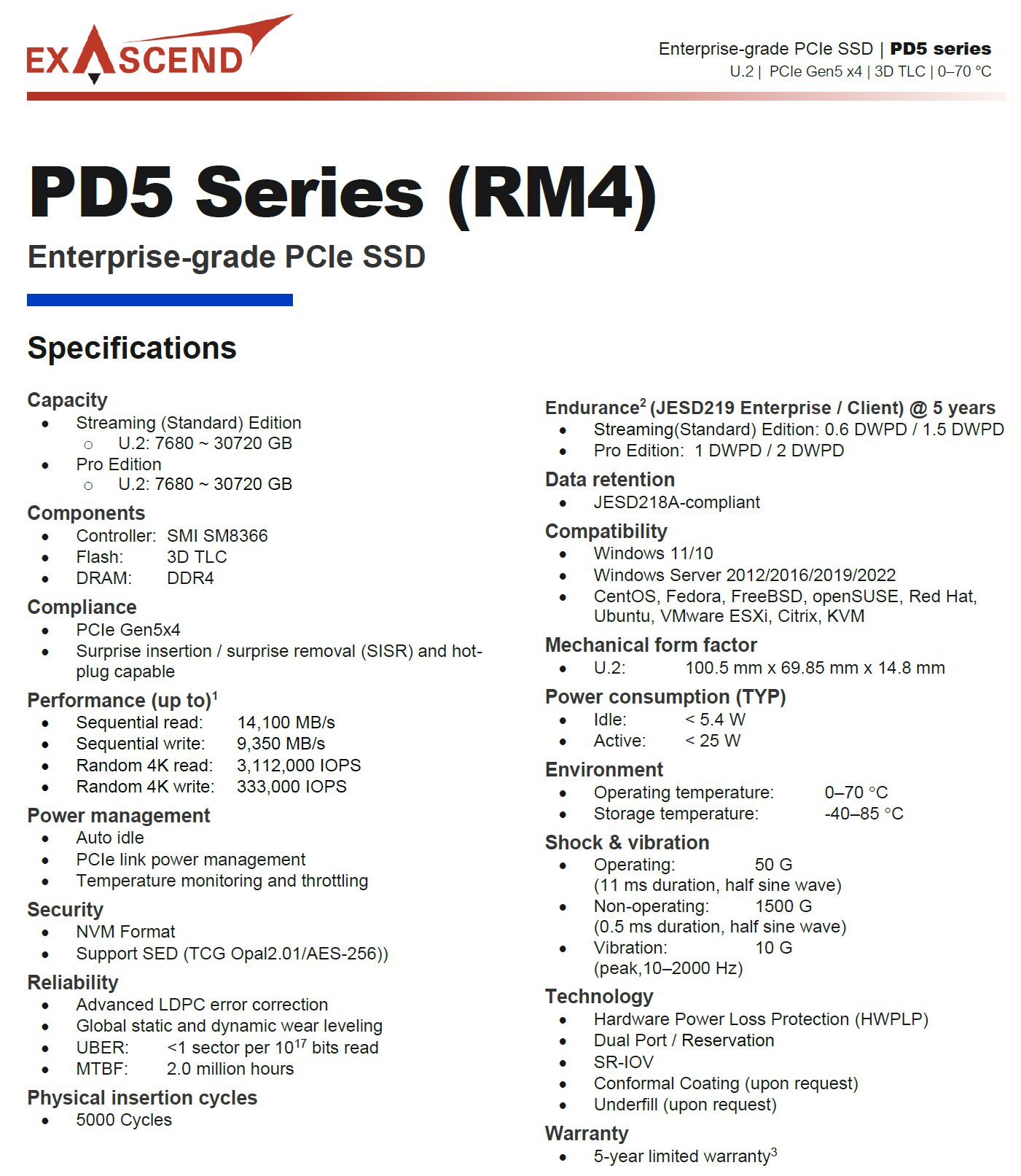
The Exascend PD5 is available in both standard and Pro Editions which affords different endurance considerations and this SSD comes with a 5-year limited warranty. Power efficiency is listed at up to 25w active and 5.4w idle. The Exascend website can be found here.
How important is real-world sustained performance compared to peak benchmark speeds when evaluating an enterprise SSD like the Exascend PD5?