 The SSD Review The Worlds Dedicated SSD Education and Review Resource |
One might be inclined to think a company exudes confidence with respect to data storage when the first line in their product brief is, ‘The world’s fastest data center SSD’. After all, storage speed these days, especially in the enterprise and data center world, is much more complex than a simple high throughput read and write or high read IOPS, or even write IOPS. Things such as AI have increased queue depth range significantly and businesses today realize that understanding their specific workload equates to, not only computing efficiency, but also money in their pocket. Add to this numerous form factors to include U.2, U.3, E1.S and E3.S, along with the fact that we are seeing a single data center SSD that can significantly reduce what would have been the storage space of 31 SSDs prior.
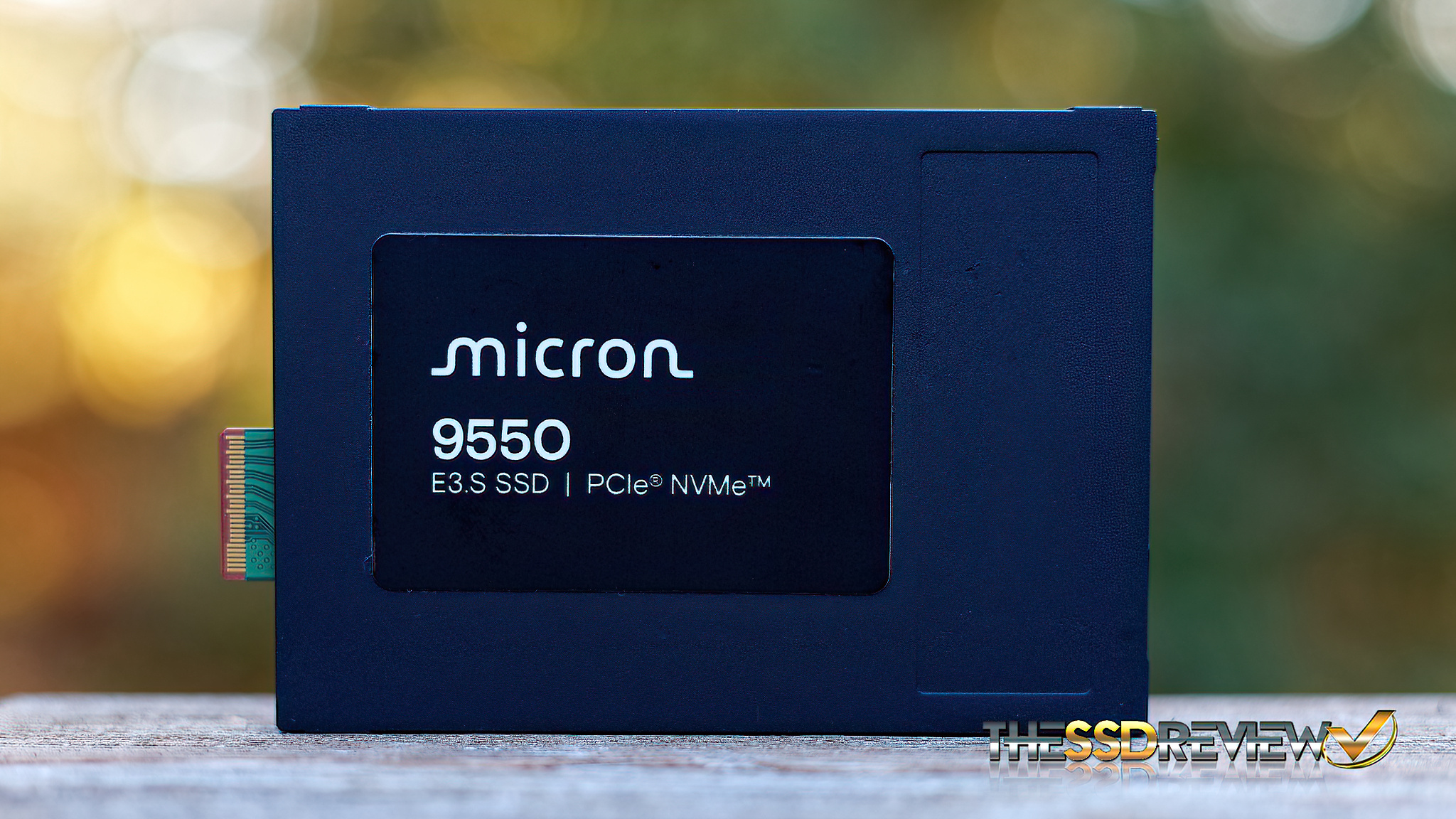
Our report today does not speak to capacity, but rather perfomance. More specifically, the performance of Micron’s 9550 MAX Gen5 12.8TB E3.S Enterprise SSD is what’s at stake, and Micron’s assertion that this specific SSD is the ‘world’s fastest data center SSD. We have tested it, mind you only against three competing enterprise SSDs from Kingston, Memblaze and Micron, and watch out world because this SSD is a rocketship… and no doubt will be situated within one soon enough (if it isn’t already).
But first, let’s sort the 9550 out. The Micron 9550 comes in two versions, PRO and MAX. The PRO version is a 1-Drive Write per Day (1-DWPD) SSD while the MAX version comes with better performance and is rated at 3-DWPD. There is significantly more NAND utilized for over-provisioning in the MAX version. This translates to better random write IOPS performance as well as those all important 70/30 mixed workload speeds, all of which can be seen in Micron’s specification sheet shown here:
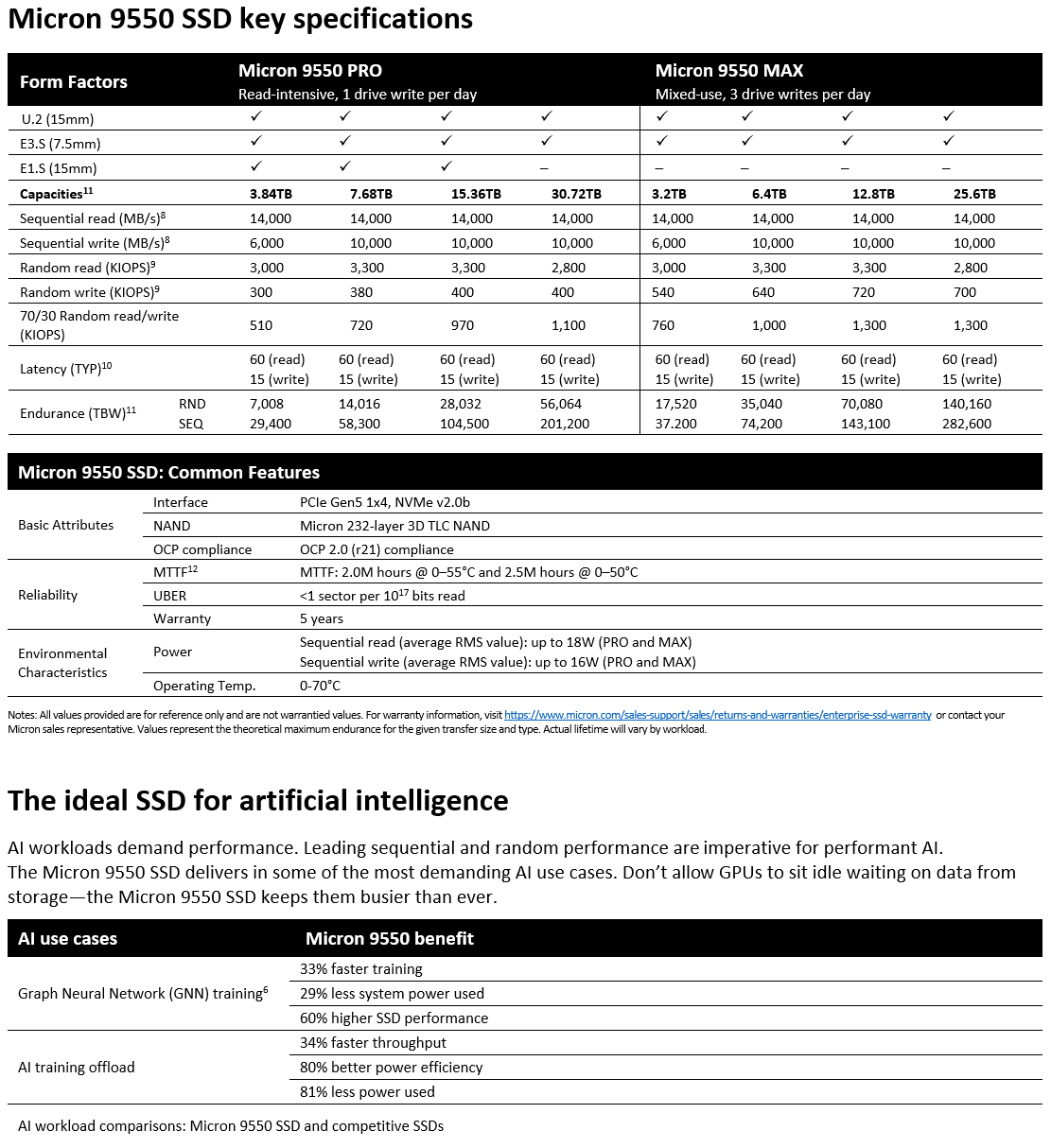
Yes we are seeing things correctly. This SSD is capable of up to 14GB/s sequential read and 10GB/s write with up to 3.3 million IOPS, along with 720K random write IOPS and 1300K 70/30 mixed load IOPS… and each and every one of these specs were surpassed in our testing. The Micron 9550 comes in two configurations for a total of eight different capacity points, is a Gen5 NVMe 2.0 SSD and is available in U.2, E1.S and E3.S form factors. Our SSD sample today is the MAX 12.8TB capacity E3.S version.
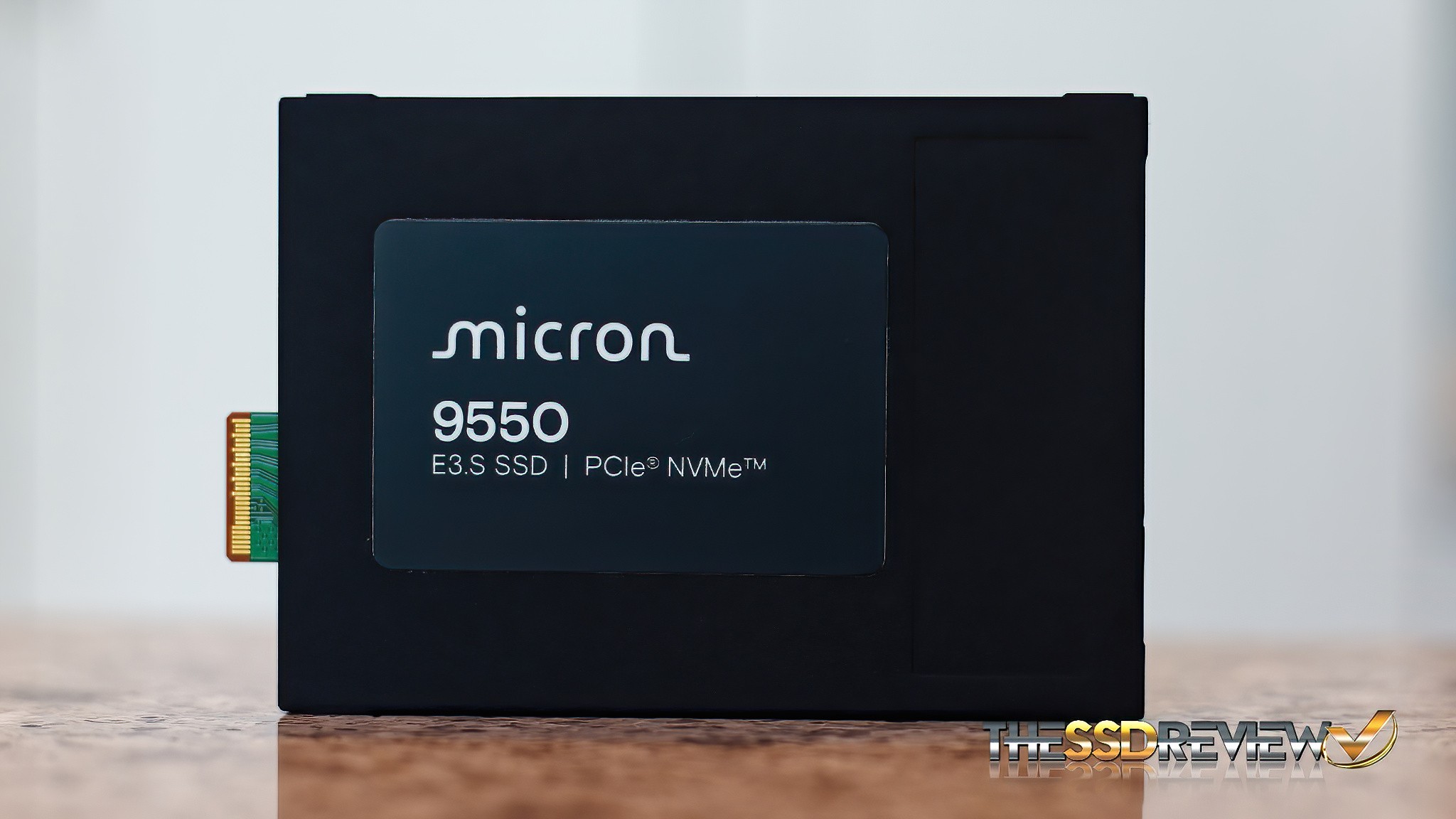
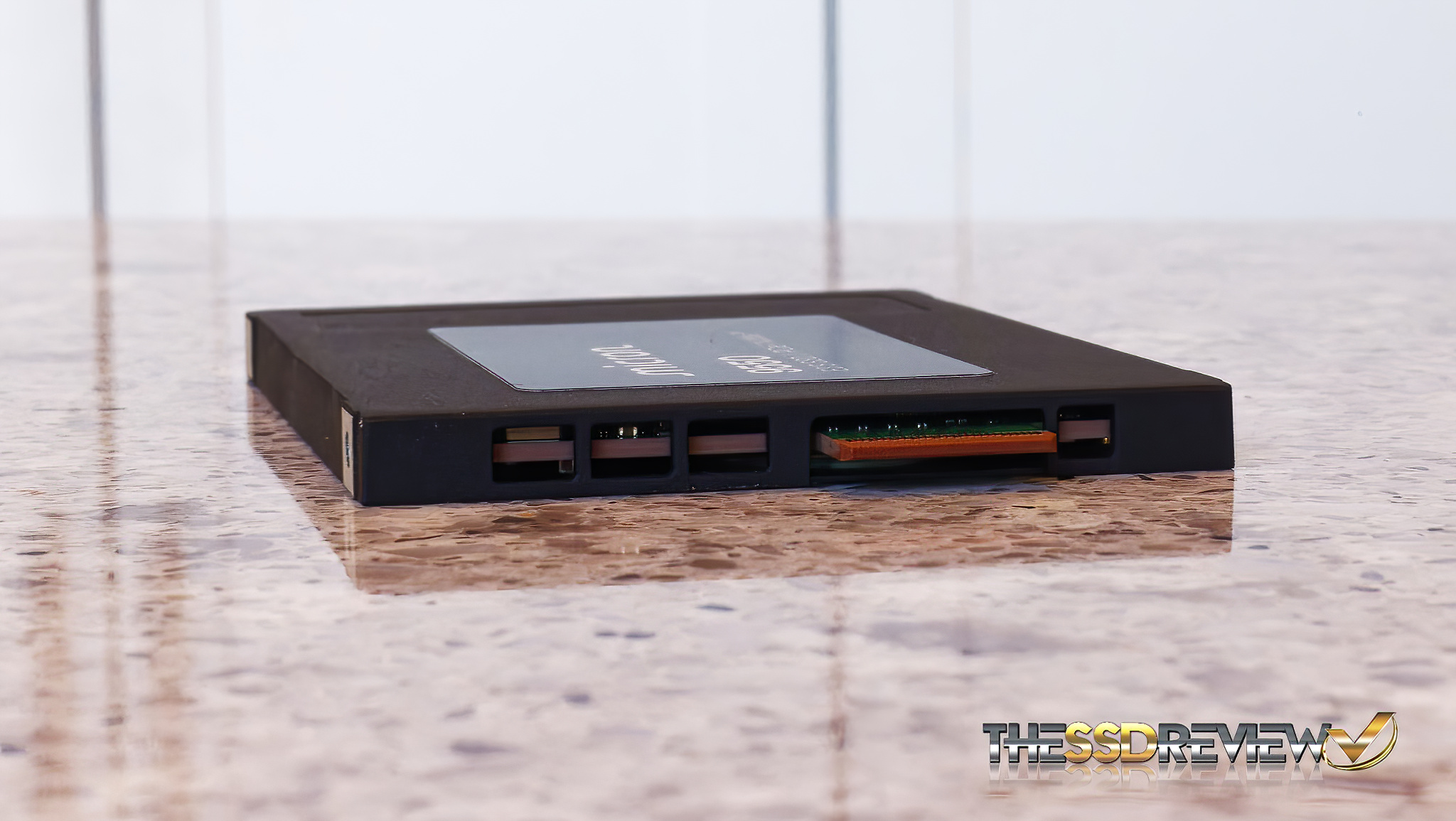
The E3.S form factor is half as thick as the U.2 2.5″ x 15mm version and measures 76mm (Width) x 112.75mm (Length) x 7.5mm (Thickness). It has openings on the top and bottom to allow for airflow through the SSD to effect component heat dissipation.
The Micron 9550 is vertically integrated, in that it contains a Micron designed 16-channel Gen5 SSD controller ASIC, Micron G8 B58r 232-layer 6-plane 3D TLC NAND flash memory, Micron DRAM and Micron produced and validated firmware. This SSD is ideal for AI workloads, OLTP, and high frequency trading.
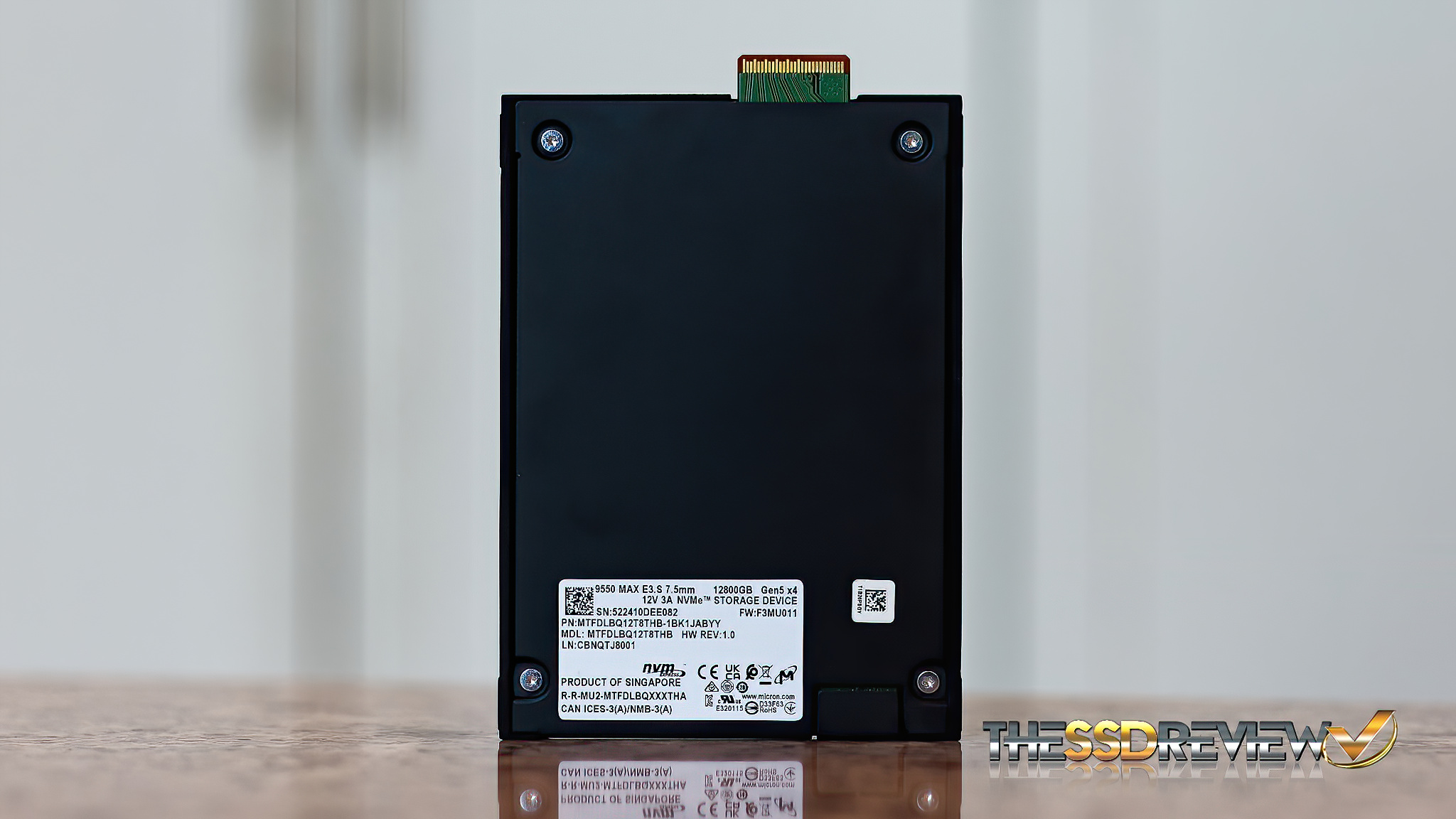
The Micron 9550 E3.S SSD is of a two piece clam shell design that protects the PCB and secures with four Torx T-5 screws. The exterior shell is of flat black aluminum. This SSD has OCP 2.0 standard support, SPDM 1.2 security, SED, Micron SEE, has power failure protection and is FIPS 140-3 Level 2 certified. It is compatible with Ubuntu, VMWare ESXi, CentOS, RHEL, SLES, FreeBSD and Windows Server.
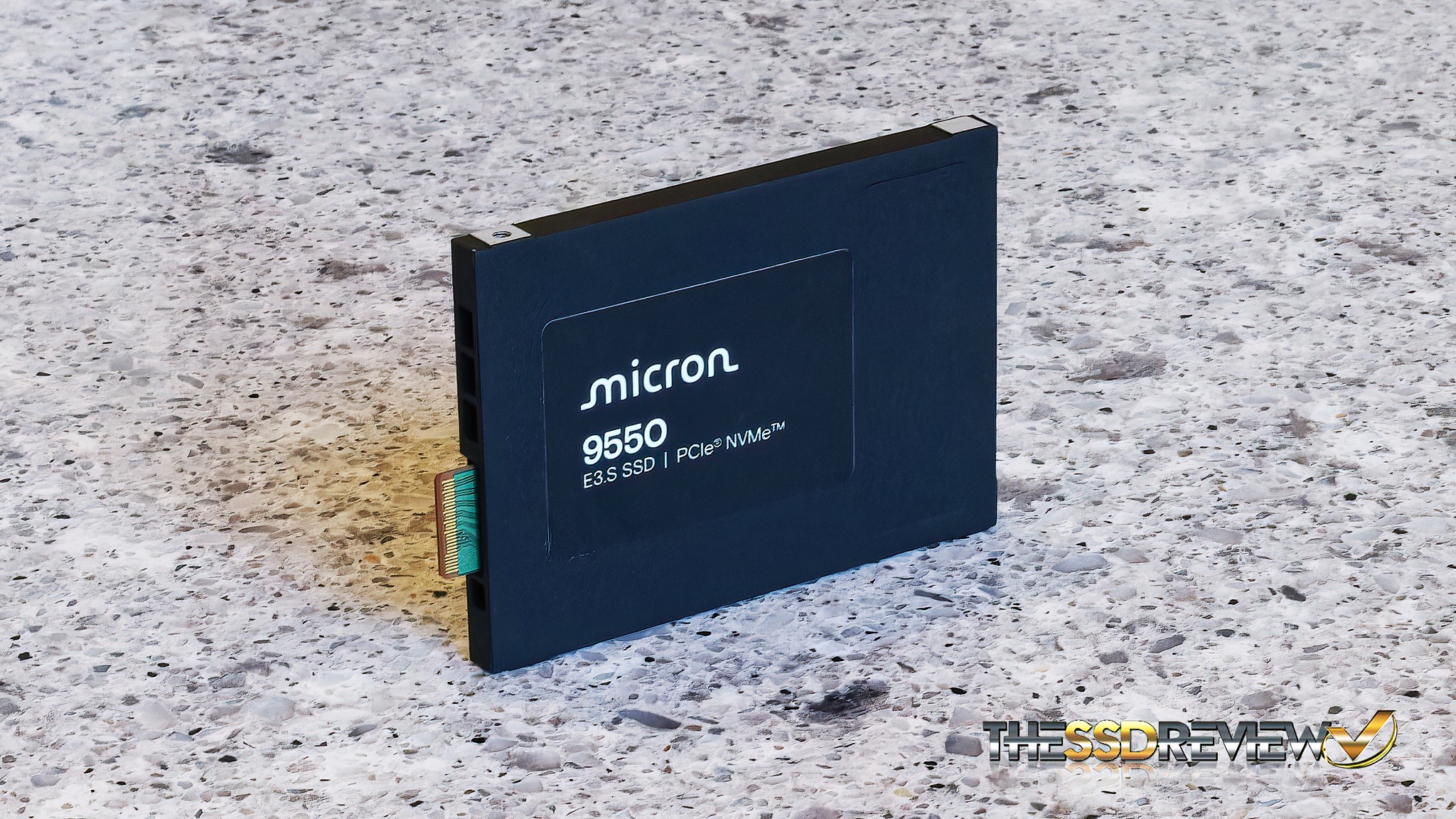
Both versions of the Micron 9550 come with a 5-year limited warranty and there is mass availability of this SSD on Amazon. The sample we are reviewing today has a $3099.99 price tag.
Let’s get to the performance…