 The SSD Review The Worlds Dedicated SSD Education and Review Resource |
8K RANDOM READ/WRITE
We precondition our enterprise SSDs using 100% random 8K writes at QD256 for two drive fills. Performance data is recorded every second. We track this data to monitor the enterprise SSDs transition to steady-state and to verify that steady-state conditions are achieved before initiating queue depth testing. Steady-state is established after a full drive fill and the average steady-state 8K random write performance is approximately 525K IOPS while using 2:1 compression.
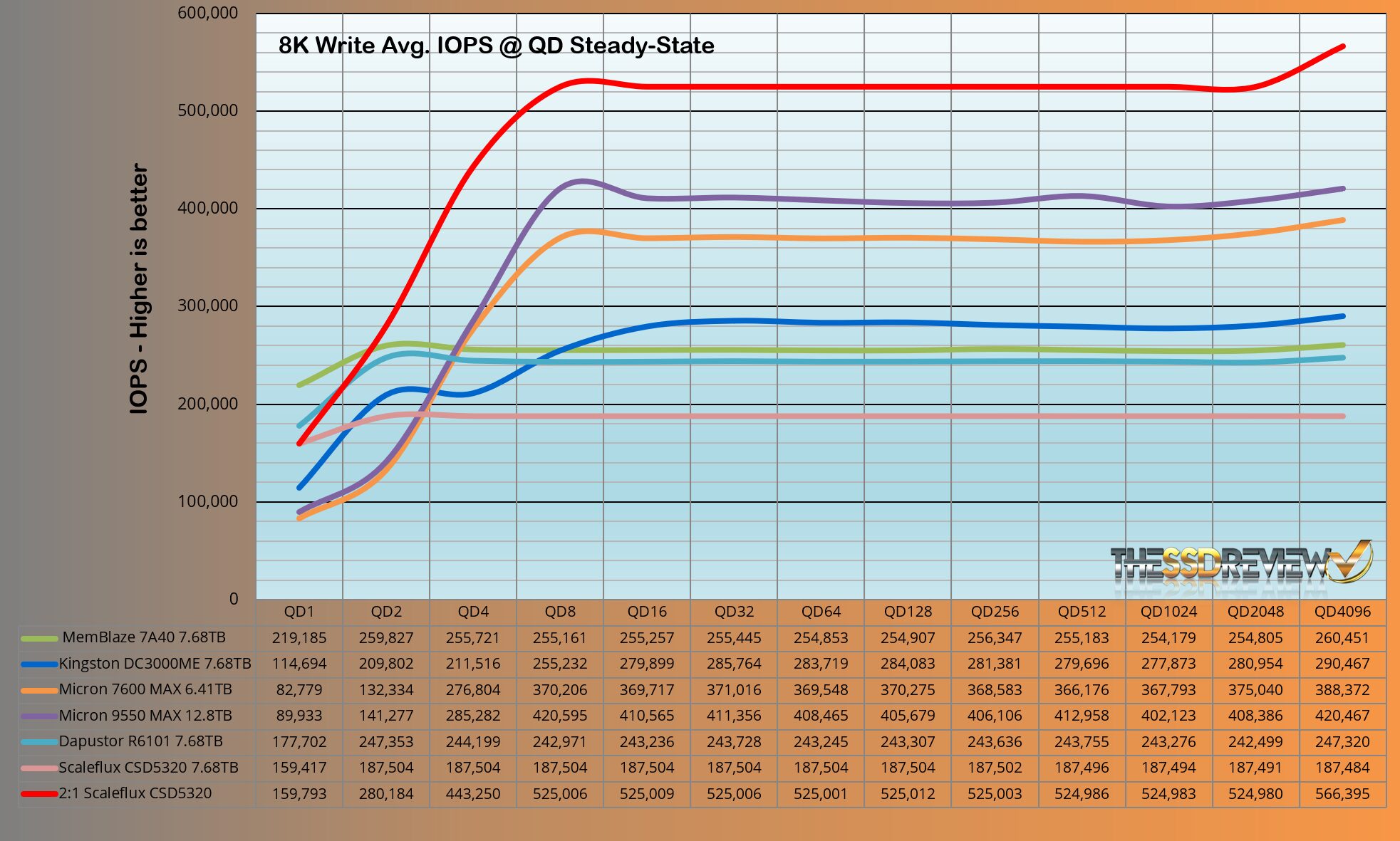
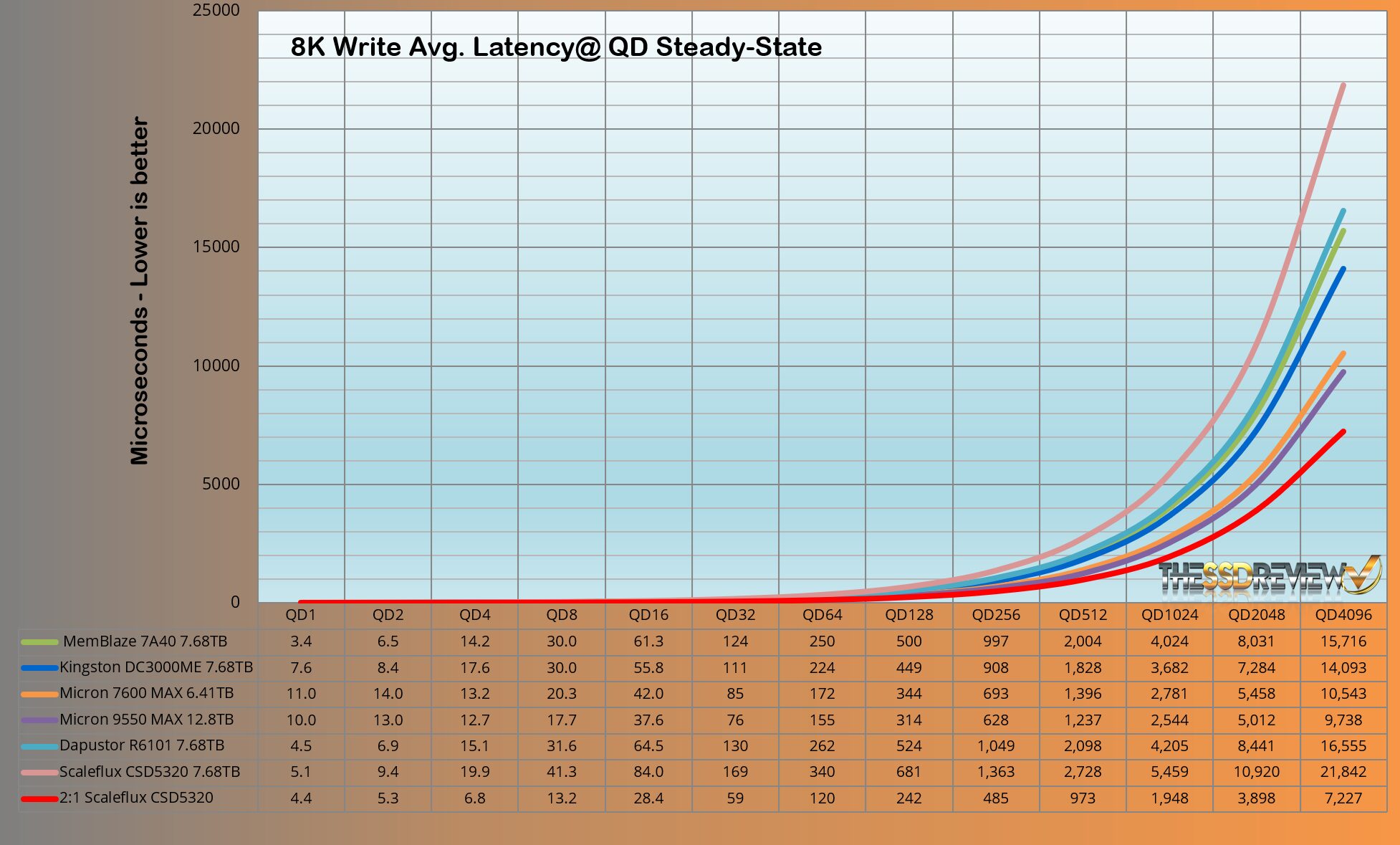
The full performance average of the ScaleFlux CSD5320 in 8K random write is 525K IOPS in 2:1 compression mode which we expected to be half of that of 4k as it is moving twice the amount of data. It levels off at QD16 right through to QD2048 and remained dead steady at 525K for most of that run. While not using compression, the CSD5320 returned a 187K IOPS result which again maintained a completely straight performance curve from QD4 to QD4096.
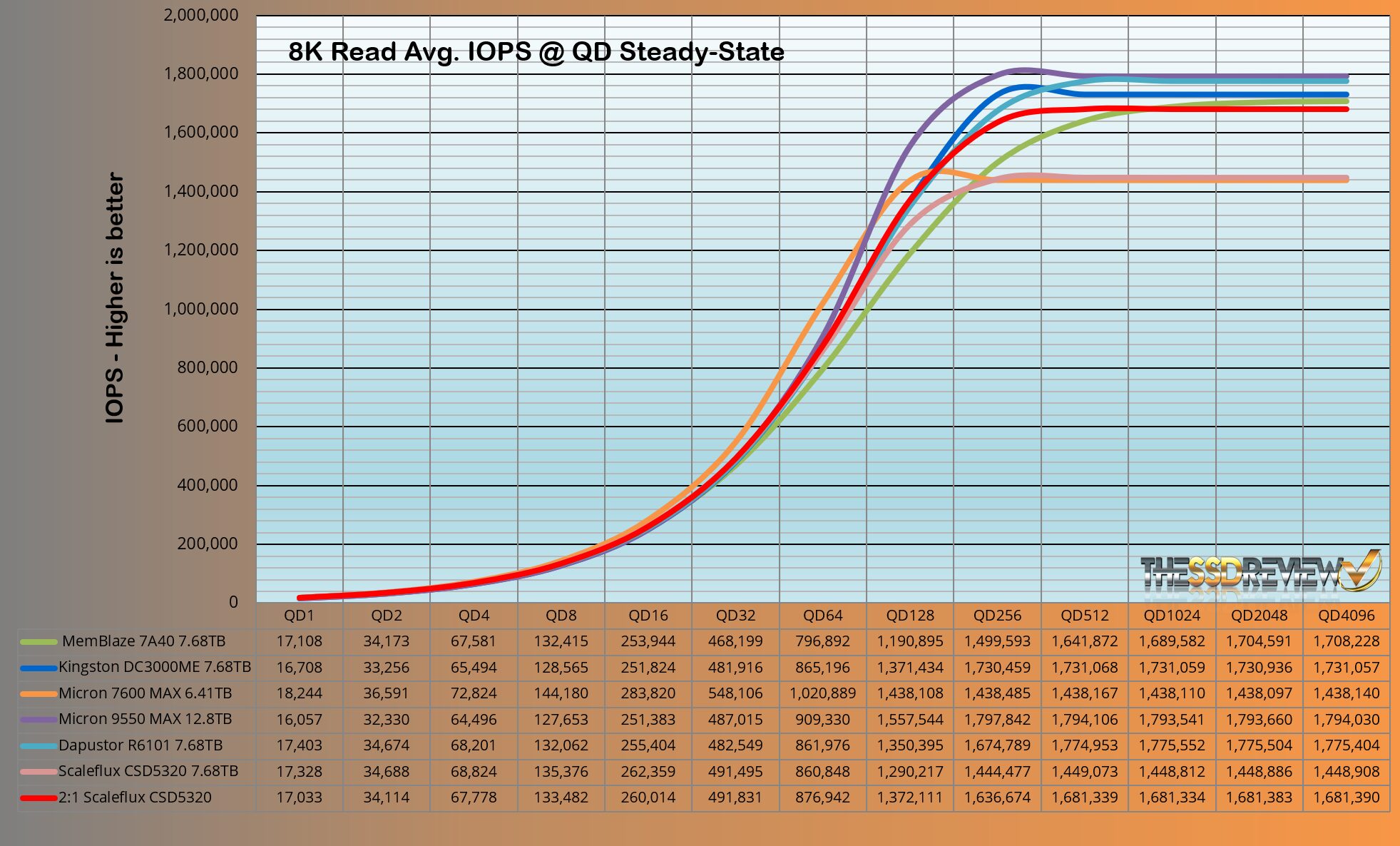
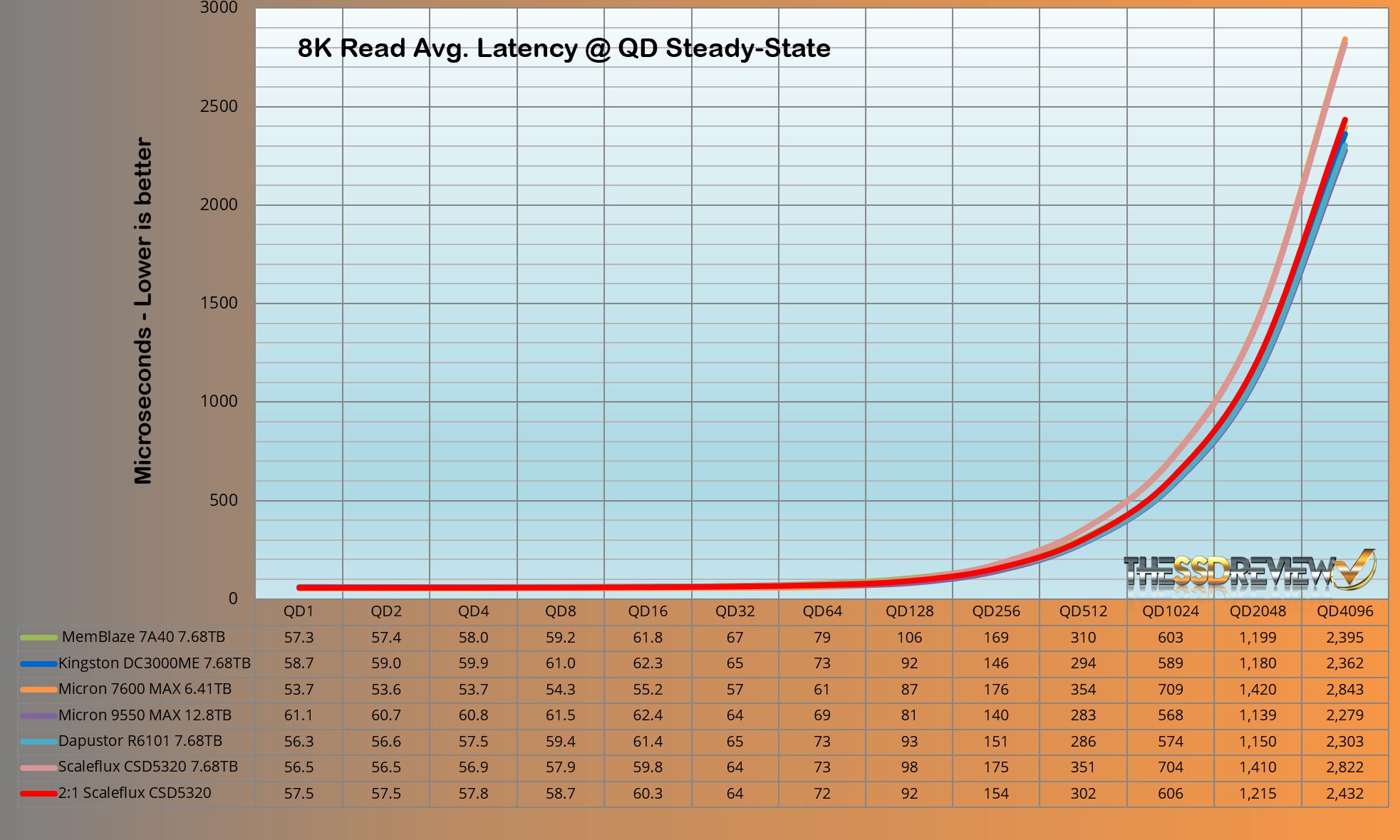
The ScaleFlux CSD5320 8K read performance of 1681K IOPS with 2:1 compression is impressive and this is reduced to 1448K IOPS otherwise.
8K 70/30
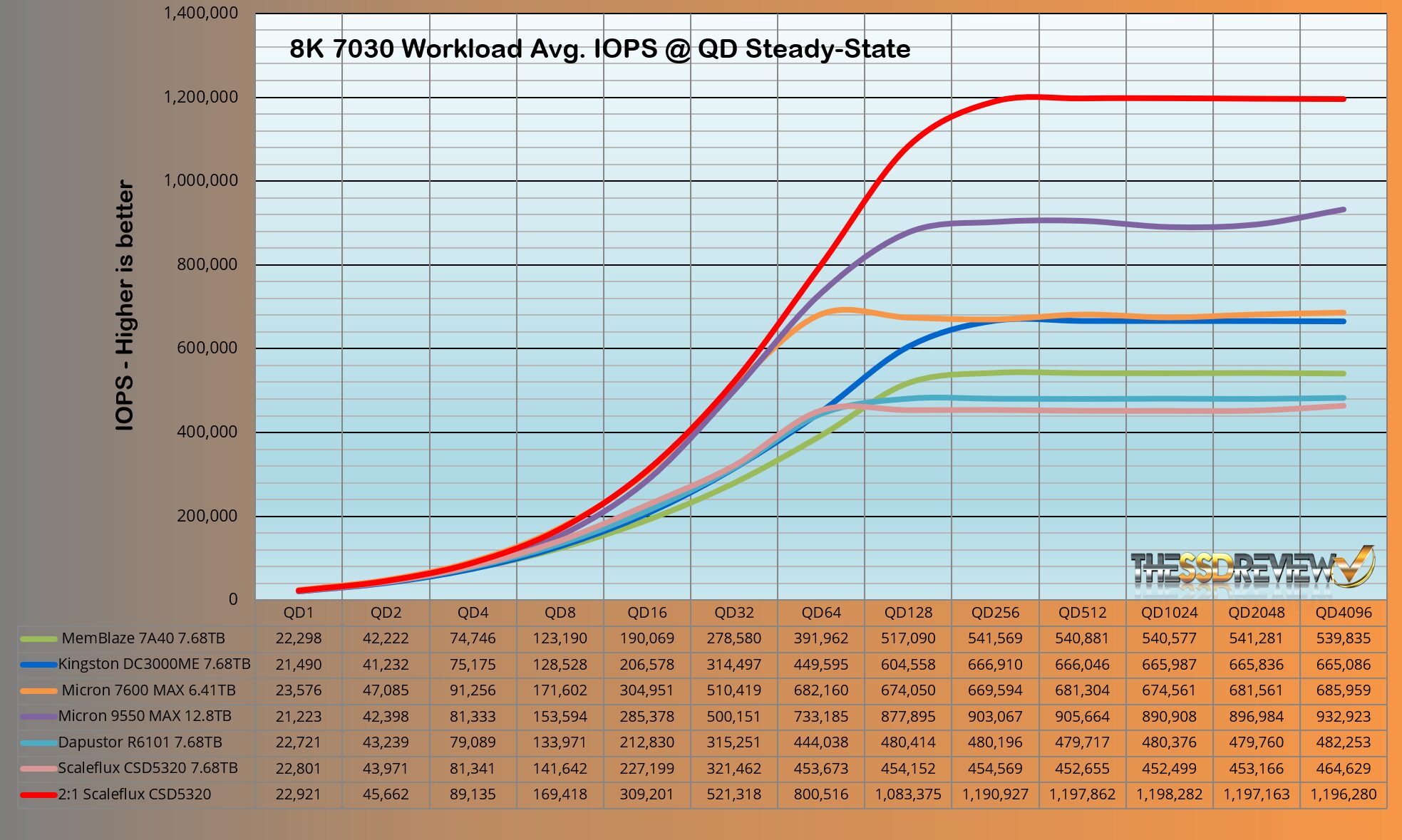
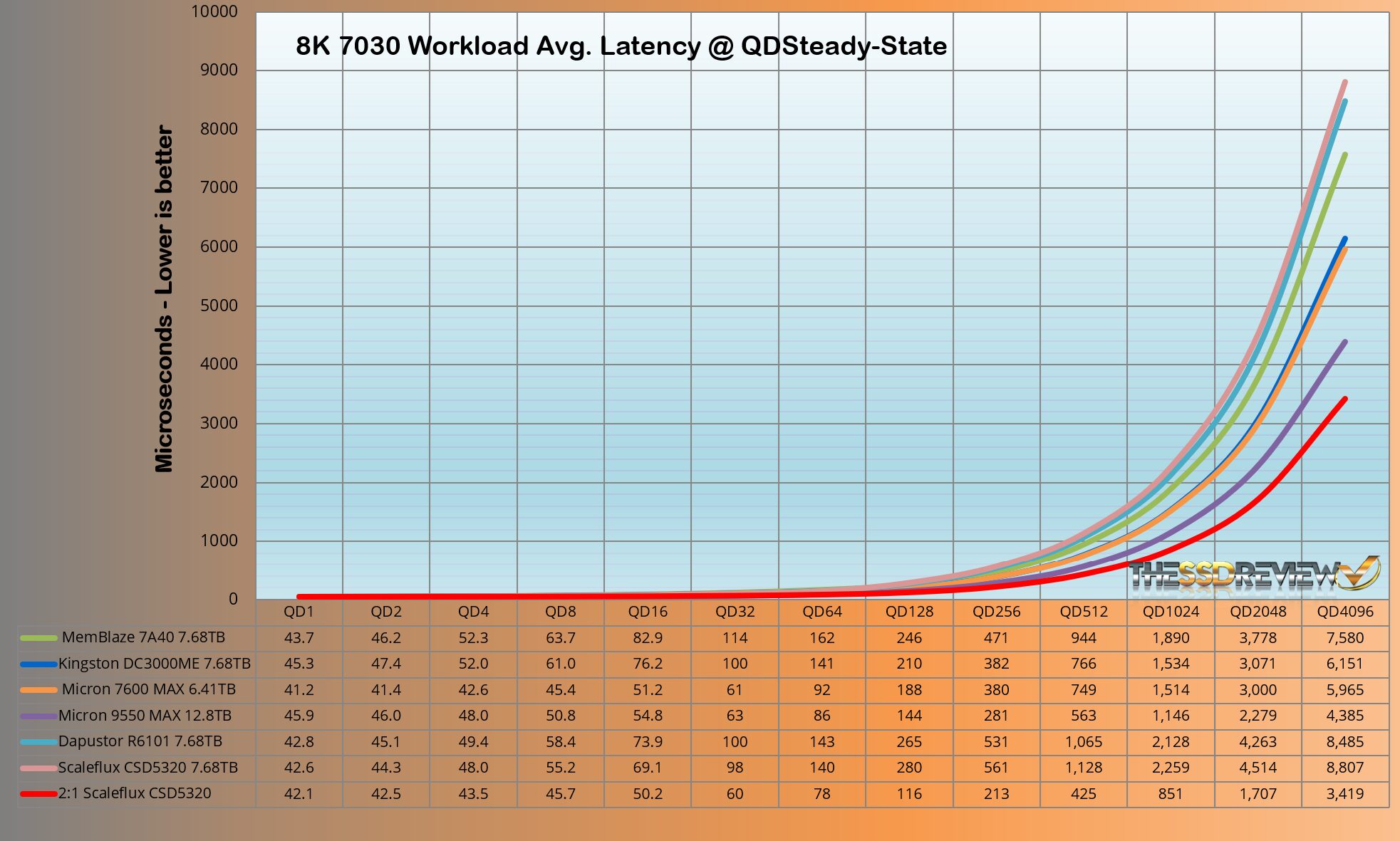
8K 70/30 is representative of a typical database workload and, where we once thought the Micron 9550 had a point to prove with its speed, the CSD5320 has done much the same by topping that Micron 9550 result significantly. Without 2:1 compression, the CSD5320 returned an average 452K IOPS, whereas with 2:1 compression activated, it jumped to 1196K IOPS leaving the rest behind.
8K 50/50
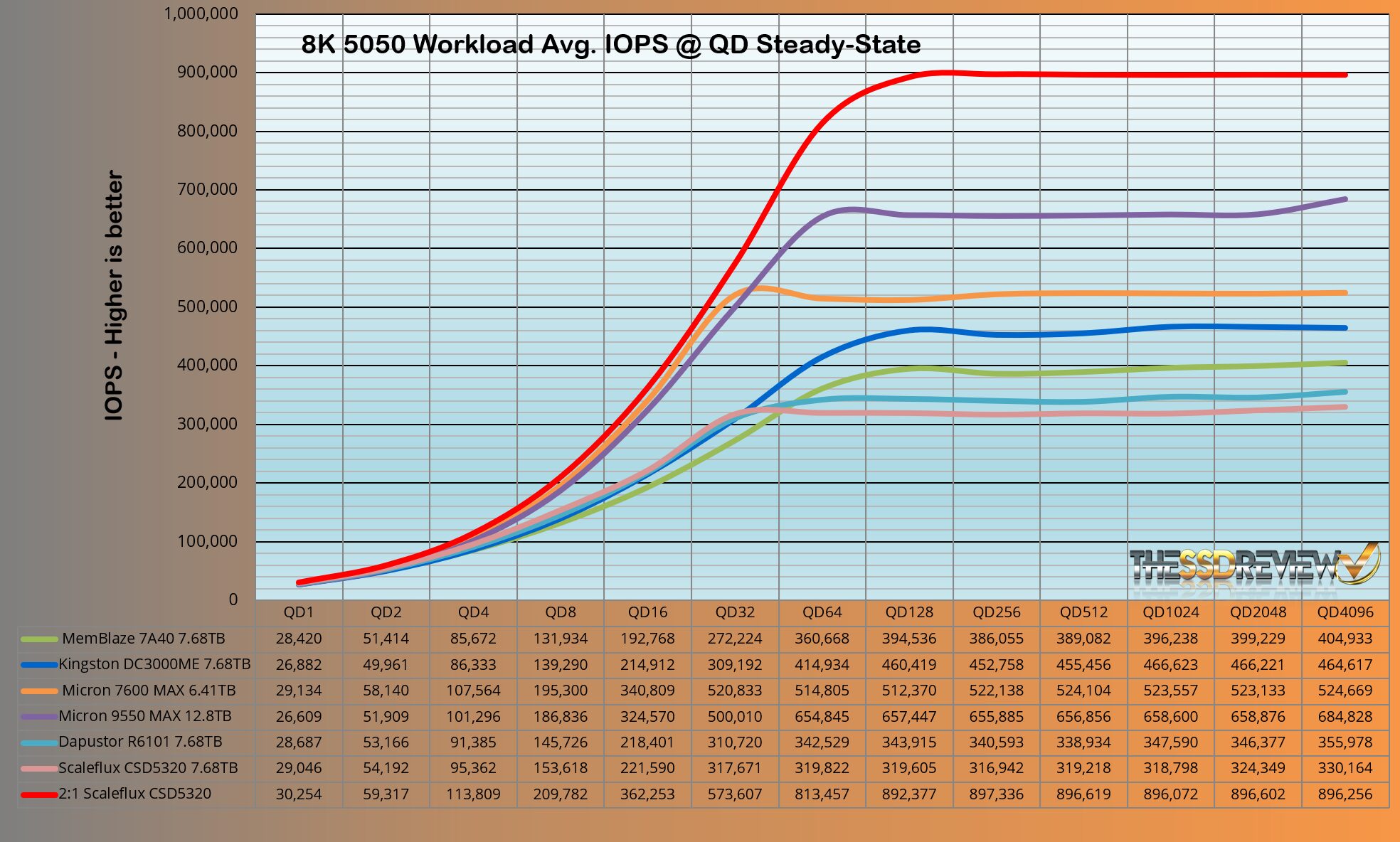
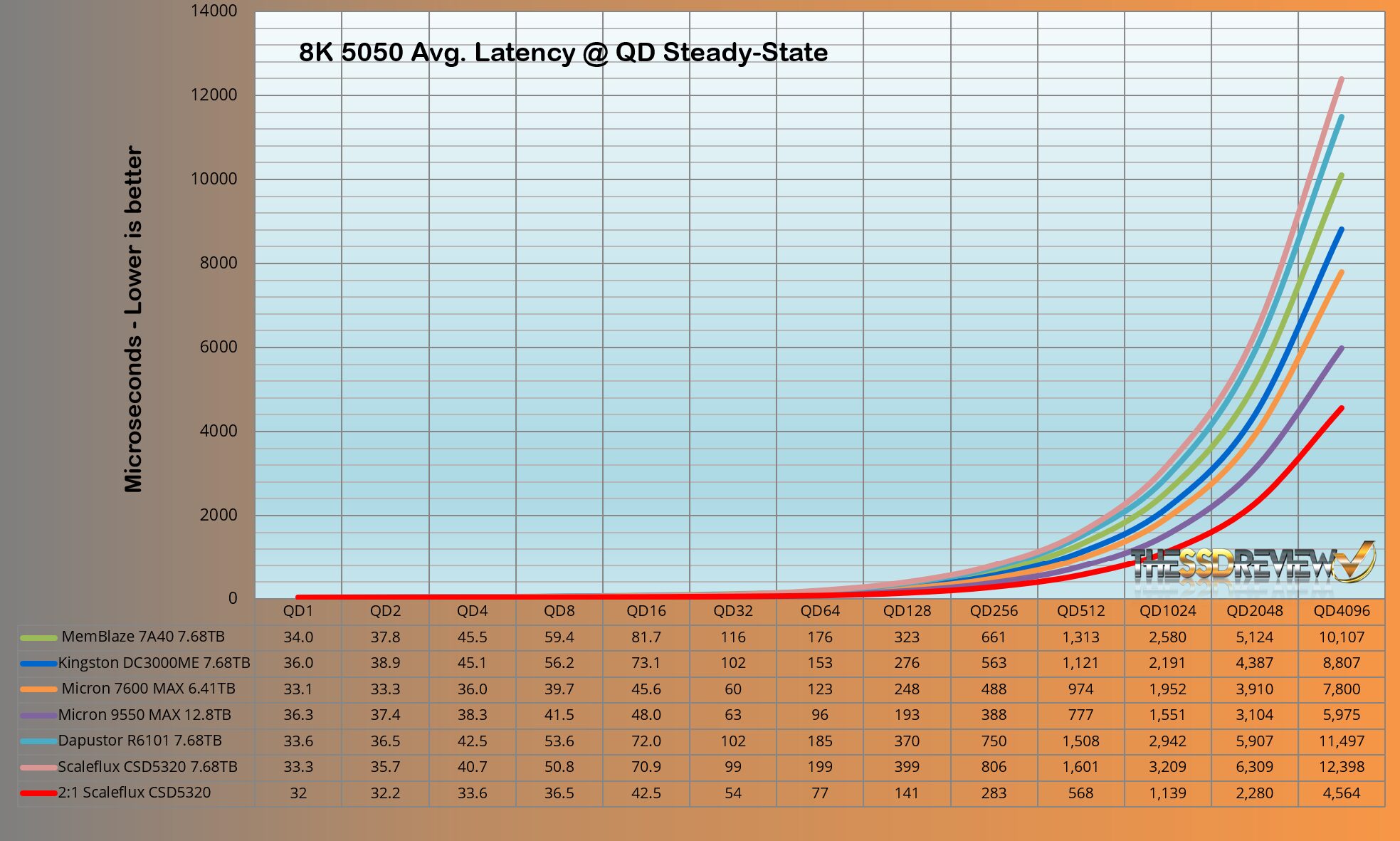
The ScaleFlux CSD5320 maintained an average of 319K IOPS throughout QD 64-4096 which jumped to the top position once again at 896K IOPS. No other SSD to date even comes close to this.
REPORT SUMMARY AND FINAL THOUGHTS
In trying to sum up the characteristics of the Scaleflux CSD5320 Enterprise SSD, one could almost state that this is a Gen5 ‘Superpower’. In normal circumstances, it provides typical (if not a bit low) Gen5 enterprise SSD performance, but when 2:1 compression is in place, watch out! This SSD is dynamite and there is nothing comparable on the market. It has no competition in 128K sequential write throughput, 4K write, 4K 70/30 and 4K 50/50K IOPS, as well as 8K write, 8K 70/30 and 8K 50/50 IOPS. One could say this is the Clark Kent of enterprise SSDs.
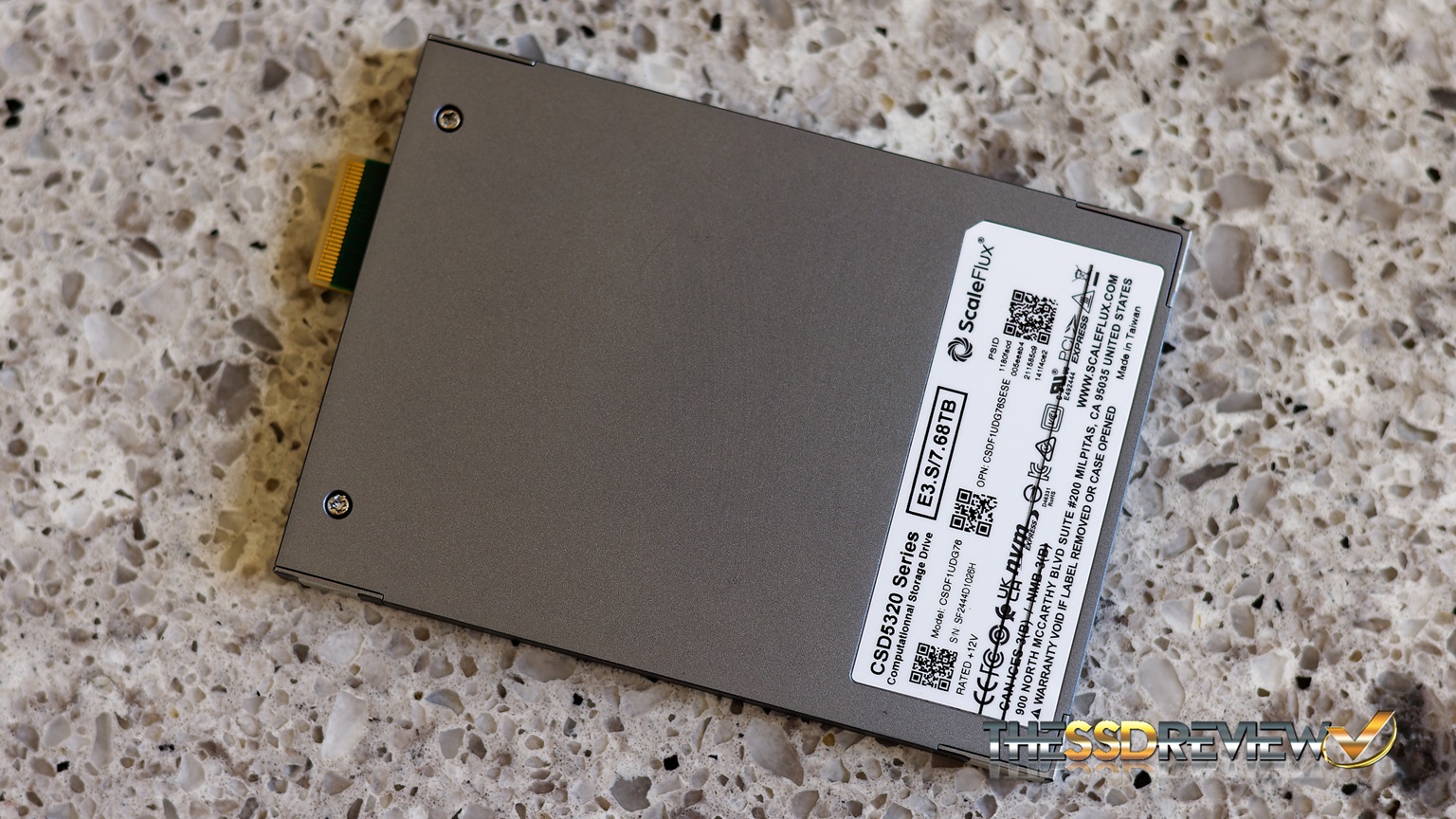
As much as we get tempted to brag about the performance of the CSD5320, there is just so much more considering that it can get up to 20x storage density, 4x power efficiency and up to 6x the endurance of its competitor. ScaleFlux relates that the present price for the CSD5320 is $880 when purchased through them directly, this price being an excellent price when compared to competing enterprise SSDs.
Although the Scaleflux CSD5320 has amazing performance all around, it truly shines in write-intensive applications and would be ideally suited for Online Transaction Processing (OLTP), high performance computing (HPC), heavy data workloads, data logging and big data analytics, to name just a few. Editor’s Choice.
CHECK FOR SCALEFLUX CSD5320 SSD PRICING AT AMAZON

Strange, could not find ANY information about the Future Storage FSSC21AD240M4 (and other capacities) online. Seems like it was just a prototype that you have. However, based on the SSD you have with Toshiba NAND, it is most likely to be equivalent to the Mushkin Chronos DX 240GB as it also used Toshiba NAND and even almost has the same circuit board layout!
That being said, SSDs had evolved a lot over the recent years with these new Gen5 SSDs and even soon, Gen6 SSDs!! The performance of the Scaleflux CSD5320 is just INSANE!!