 The SSD Review The Worlds Dedicated SSD Education and Review Resource |
TSSDR TEST BENCH AND PROTOCOL
SSD testing at TSSDR varies slightly depending on whether we’re evaluating consumer or enterprise storage. For today’s review of the Corsair MP700 Micro Gen5 4TB SSD, our objective is to test it within a system optimized through standard BIOS settings—such as enabling XMP 3—for the best possible performance.
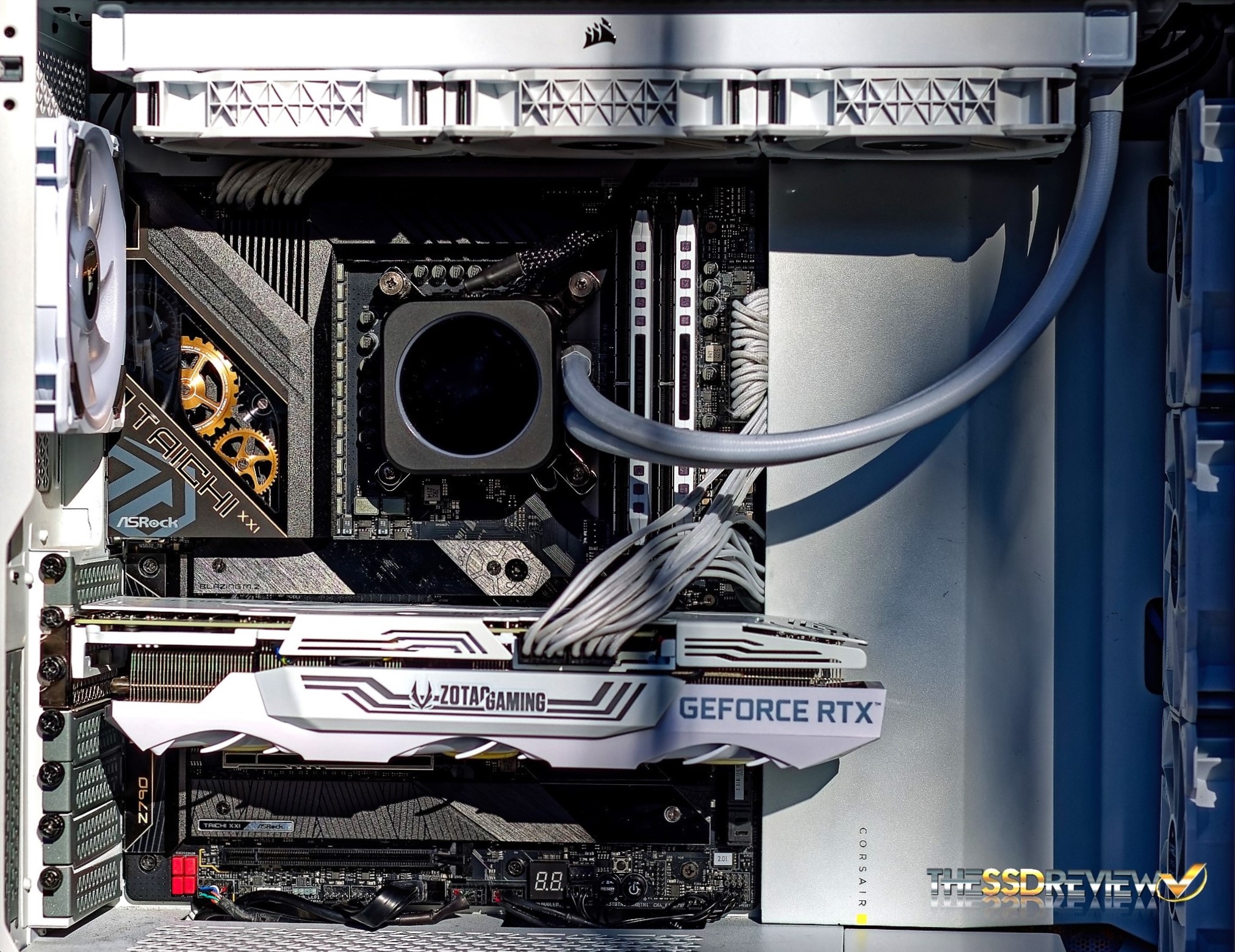
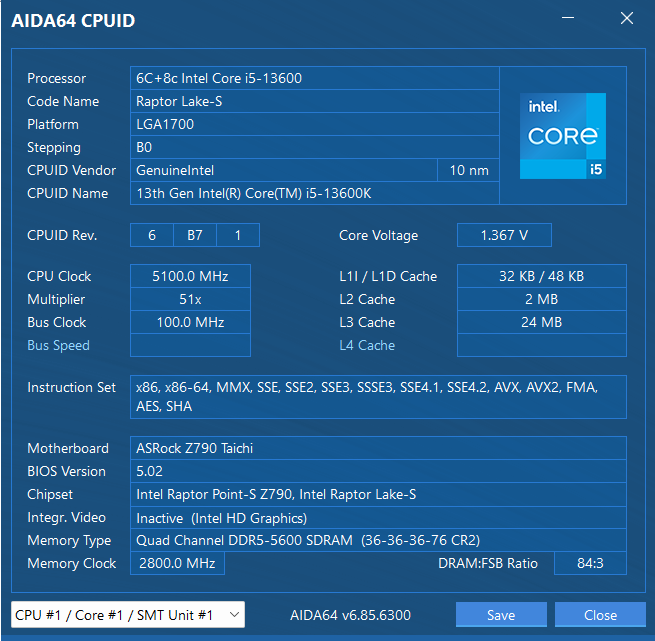
For this Test Bench, no BIOS-specific performance tweaks were applied. Our new ASRock Z790 Taichi motherboard automatically pushed the system beyond 5GHz, while the 32GB Corsair Dominator Platinum DDR5 memory stabilized at 5600MHz.
The components used in this Test Bench are listed in the title link below. Each item is linked for easy access, allowing you to view or purchase the products with a simple click.
ASROCK Z790 TAICHI PCIE 5.0 TEST BENCH COMPONENTS
| PC CHASSIS: | Corsair 5000D RGB White Tempered Glass Chassis |
| MOTHERBOARD: | ASRock Z790 Taichi |
| CPU: | Intel 13th Gen Core i9-13900K |
| CPU COOLER: | Corsair Hydro Series H150i Capellix White |
| POWER SUPPLY: | Corsair HX1000i Platinum Modular 80Plus |
| GRAPHICS: | ZOTAC GeForce RTX 3080 Trinity White |
| MEMORY: | Corsair Dominator Platinum RGB DDR5-5600 |
| STORAGE: | Sabrent Rocket 4 Plus Gen 4 4TB NVMe SSD |
| KEYBOARD: | Corsair K70 PRO RGB Optical Mechanical Gaming |
| MOUSE: | Corsair M65 RGB Elite FPS Gaming |
| MONITOR: | Samsung 34 Inch 1440p WQHD Ultrawide Gaming |
BENCHMARK SOFTWARE
The software used for today’s analysis mirrors that of many of our previous reviews and includes Crystal Disk Info, ATTO Disk Benchmark, Crystal Disk Mark, AS SSD, Anvil’s Storage Utilities, AJA, TxBench, PCMark 10, 3DMark, and the Final Fantasy XIV Gaming Benchmark, along with real data testing. This selection ensures each benchmark complements and validates the results of the others, providing a thorough performance evaluation.
A WORD ABOUT PERFORMANCE AND BUILDS
We’ve recently upgraded to our latest Ultra 200 Series Z890 Test Bench, however, we’ve found that our Z790 Test Bench still delivers the best overall performance for this report. Our goal remains to provide readers with the most accurate representation of an SSD’s full potential.
That said, choosing the right CPU can influence results. AMD processors typically excel in high sequential performance, while Intel CPUs lead in low random performance. We’ve long favored Intel-based test benches, and this review continues in that tradition.
Upgrading our test platforms roughly every two years can introduce slight performance shifts, which we note in our comparison charts until there’s enough Gen5 data to justify a dedicated chart. Our focus is to present the best possible results for each SSD tested. For transparency, readers can always refer back to previous reviews to confirm the test system used. Realistically, retesting hundreds of drives with each platform change isn’t feasible. Thank you for your understanding.
CRYSTAL DISK INFO VER. 8.17.7 X64
Crystal Disk Info is an excellent utility for monitoring the characteristics and overall health of storage devices. It provides detailed information such as temperature, total power-on hours, and even the device’s current firmware version.
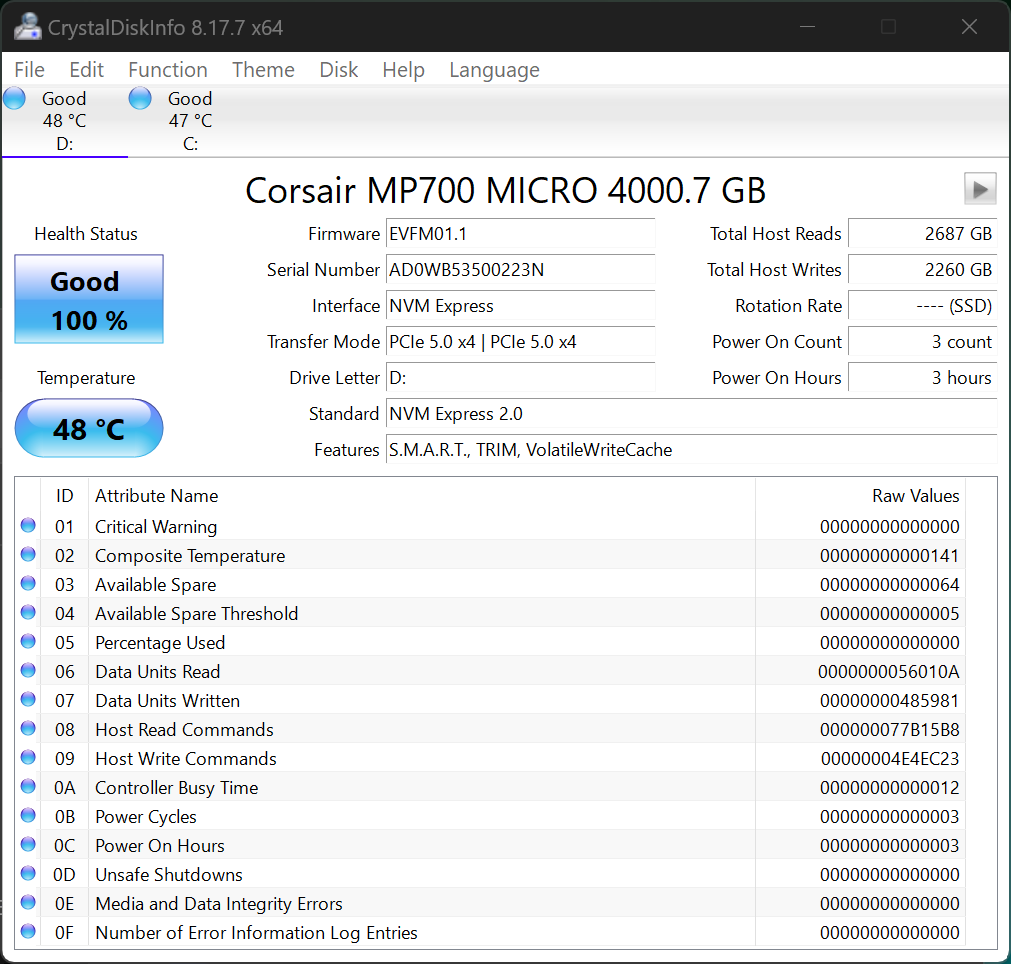
Crystal DiskInfo validates that our SSD is running in PCIe 5.0 x4, using the NVMe 2.0 protocol and confirms that it is TRIM capable.
ATTO Disk Benchmark is one of the longest-standing benchmarking tools and remains a core standard for manufacturer performance specifications. It tests using raw, compressible data. For our benchmarks, we use a fixed 256MB test file and measure both read and write performance across transfer sizes ranging from 0.5KB to 8192KB. Manufacturers favor this approach because it uses compressible data, which produces higher performance results compared to random, incompressible data that more closely reflects real-world usage.
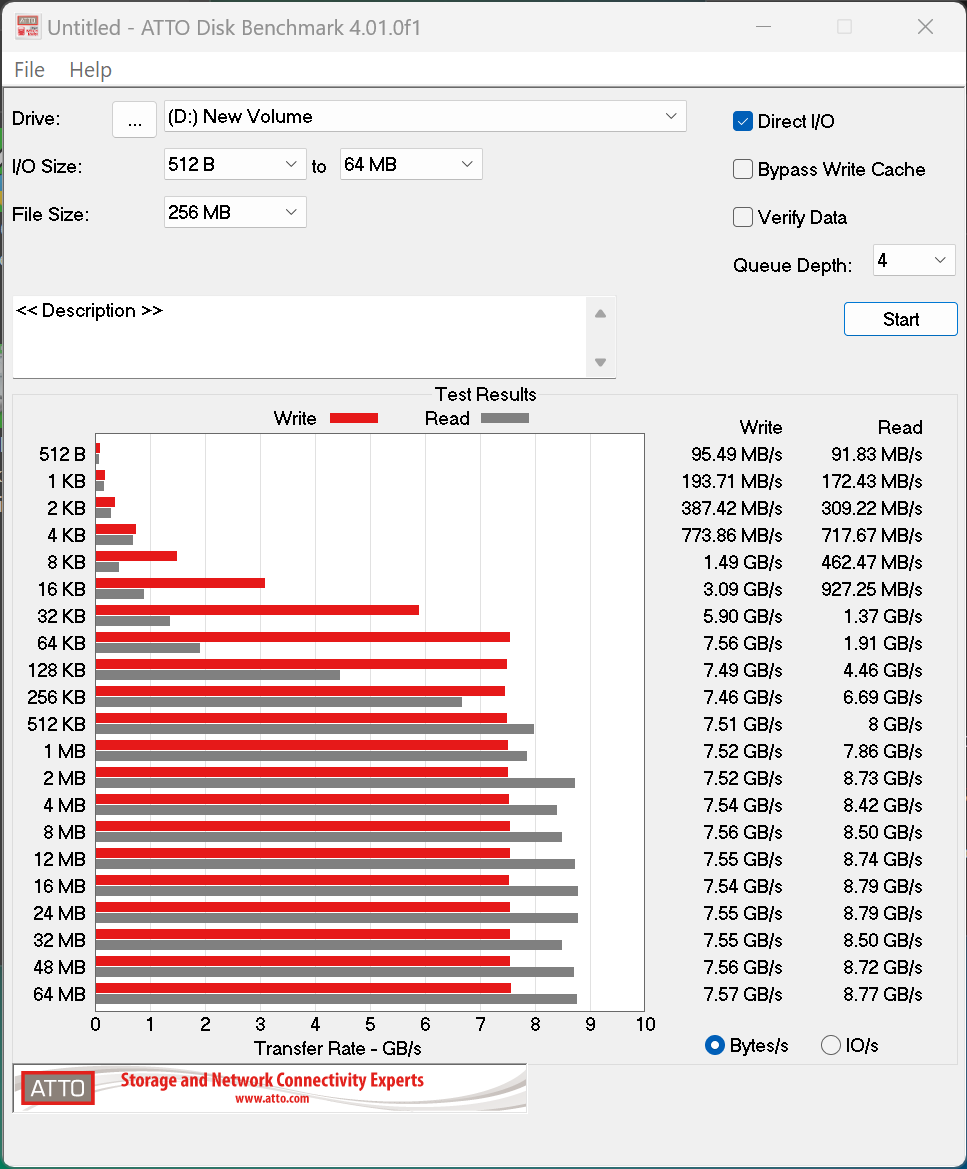
ATTO performance hits highs of 8.79GB/s read and 7.57GB/s write which is below listed specs as is the norm for ATTO.
It is now only a matter of time until we will see PCIe 5.0 NVMe SSDs in a 2230 form factor soon! Hopefully, by 2026! Insane out of the world speeds in a small form factor!
Absolutely agree! Looking forward to seeing insane speeds in a very small 2230 form factor very soon!
Who knows, maybe in CES 2026 we will see these SSds already!
There is an error in the MS direct storage section, it says [“increasing” game load times], but I would have thought the author meant to say [“decreasing” game load times].
Ref:
As our Corsair MP700 Micro 4TB SSD is MS DirectStorage compatible, we thought we might take advantage of the 3DMark DirectStorage Feature Test and see how this SSD fared. MS DirectStorage, in very basic terms, allows direct transfer of data from your SSD storage directly to your GPU, eliminating its historical necessary passage from the SSD through the CPU to RAM, back through the CPU and finally to the GPU VRAM. This is, for the most part at this time, intended on [increasing game load times],reducing CPU overhead and providing more detailed graphics.
I agree, noticed it too. I believe the author meant to say “faster loading times” instead of “increased loading times”.
As an example, Diablo IV (the game I play) support Microsoft DirectStorage, therefore leading to faster loading times. (Although Diablo IV had issues with DirectStorage before, the problem appeared to been fixed now).
Fixed Thanks.